AI + Human Flow
Where humans and AI do their best work together.
A practical model for how humans and AI work together in a continuous improvement cycle, beyond ad hoc AI use, into structured, safe, scalable ways of working.
The Flow
defines the problem
Sets context, intent, guardrails and the outcome that matters.
→generates possibilities
Drafts options, surfaces patterns, accelerates analysis at scale.
→validates
Applies judgement, ethics, domain expertise and risk thinking.
→accelerates delivery
Automates the repeatable. Compresses cycle time. Removes toil.
→owns the outcome
Stays accountable for impact, learning and continuous improvement.
Business
Problem
Define
The human defines the problem, sets context, asks the right questions, clarifies goals, and establishes guardrails.
Run
The AI agent generates responses, analyses information, drafts options, identifies patterns, and assists with execution.
Review
The human evaluates quality, applies domain expertise, checks risk, validates assumptions, and makes decisions.
Refine
The human provides feedback, adjusts inputs, improves prompts, updates context, and reruns the cycle.
05 — Intervention Trigger
When humans step in.
Dotted thresholds across the loop signal where human judgement overrides automation — keeping outcomes safe, ethical, and aligned with context.
- Low confidence
- Ethical or compliance risk
- Sensitive decisions
- Poor-quality output
- Missing context
- High-impact business decision
06 — Continuous Learning Loop
Each cycle improves the next — through feedback, richer context, and stronger decision-making.
The Problem
AI often needs human input and feedback at different points in a process.
AI is not always fully autonomous. Depending on the task, it may need humans in-the-loop, on-the-loop, or out-of-the-loop to make the right decisions.
Why it matters
- •Improves accuracy and trust
- •Ensures accountability
- •Optimises speed and cost
- •Enables the right level of human involvement
The 3 Human-AI Interaction Models
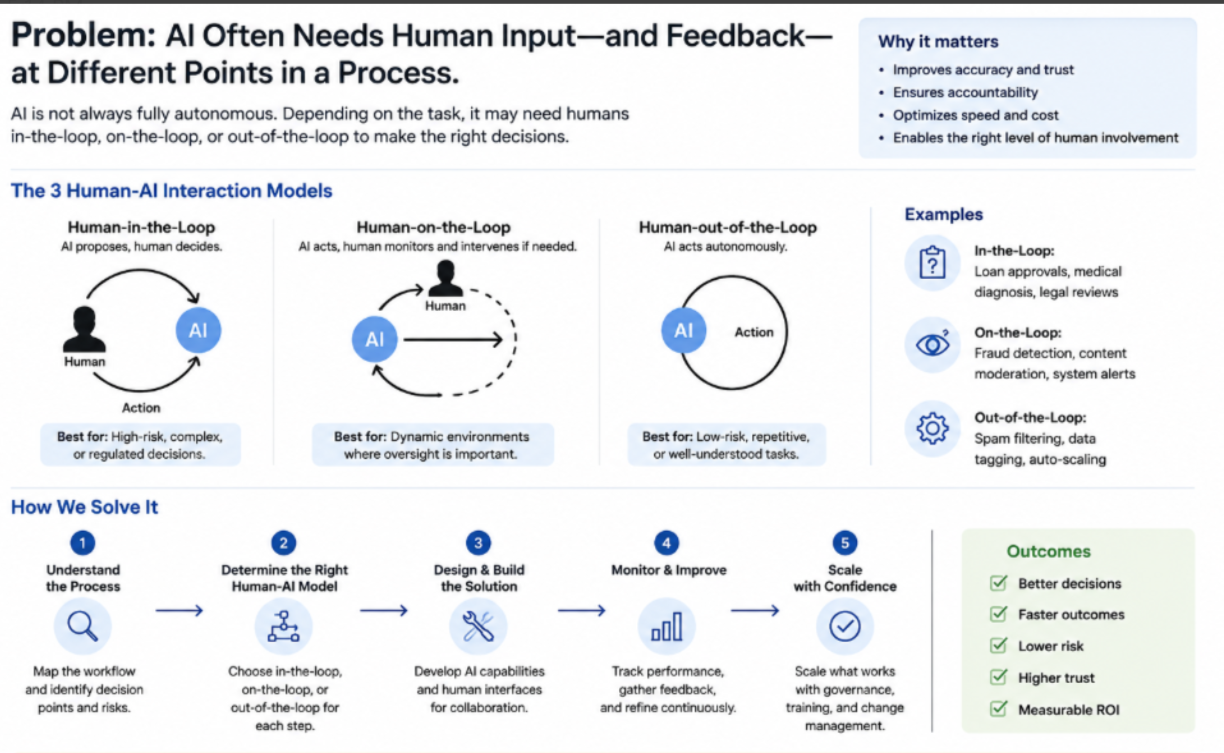
Human-in-the-Loop
AI proposes, human decides.
Best for: High-risk, complex, or regulated decisions.
Example
Loan approvals, medical diagnosis, legal reviews.
Human-on-the-Loop
AI acts, human monitors and intervenes if needed.
Best for: Dynamic environments where oversight is important.
Example
Fraud detection, content moderation, system alerts.
Human-out-of-the-Loop
AI acts autonomously.
Best for: Low-risk, repetitive, or well-understood tasks.
Example
Spam filtering, data tagging, auto-scaling.
How We Solve It
A five-step path to human-centred AI delivery.
Understand the Process
Map the workflow and identify decision points and risks.
→Determine the Right Human-AI Model
Choose in-the-loop, on-the-loop, or out-of-the-loop for each step.
→Design & Build the Solution
Develop AI capabilities and human interfaces for collaboration.
→Monitor & Improve
Track performance, gather feedback, and refine continuously.
→Scale with Confidence
Scale what works with governance, training, and change management.
Outcomes
- ✓Better decisions
- ✓Faster outcomes
- ✓Lower risk
- ✓Higher trust
- ✓Measurable ROI
AI creates speed. Humans create judgement. Together, they create better outcomes.
Book a Strategy Call →